Next Generation Gift Card
There was a time when gift cards were pretty specific in their nature of usability.
They were the thing you panic-bought at the airport; the “I didn’t know what to get you” gift; or the last-minute stocking stuffer with zero emotional depth.
But somewhere between cashback culture, rising grocery bills, and people collectively realizing budgeting apps alone won’t save them… gift cards quietly evolved.
Not as gifts. But as strategy.
And honestly? Once my friend Claire explained her ‘gift card system’ to me over overpriced iced lattes, I started seeing them completely differently.
“I don’t even wait to receive gift cards anymore,” she told me. “I buy them for myself.”
At first, I laughed.
“Isn’t that just moving your own money around?”
“Not if you’re saving while doing it,” she said.
Reader, she had a point.
Wait — People Actually Buy Gift Cards for Themselves?
A lot of people do now. And not in a weird way.
Using gift cards for self-use has become one of those low-key internet finance tricks that sounds oddly simple… because it is.
7 Smart Ways Gift Cards Work For You
People are using gift cards to stretch grocery budgets, earn cashback, stack discounts or maximize rewards during sales.
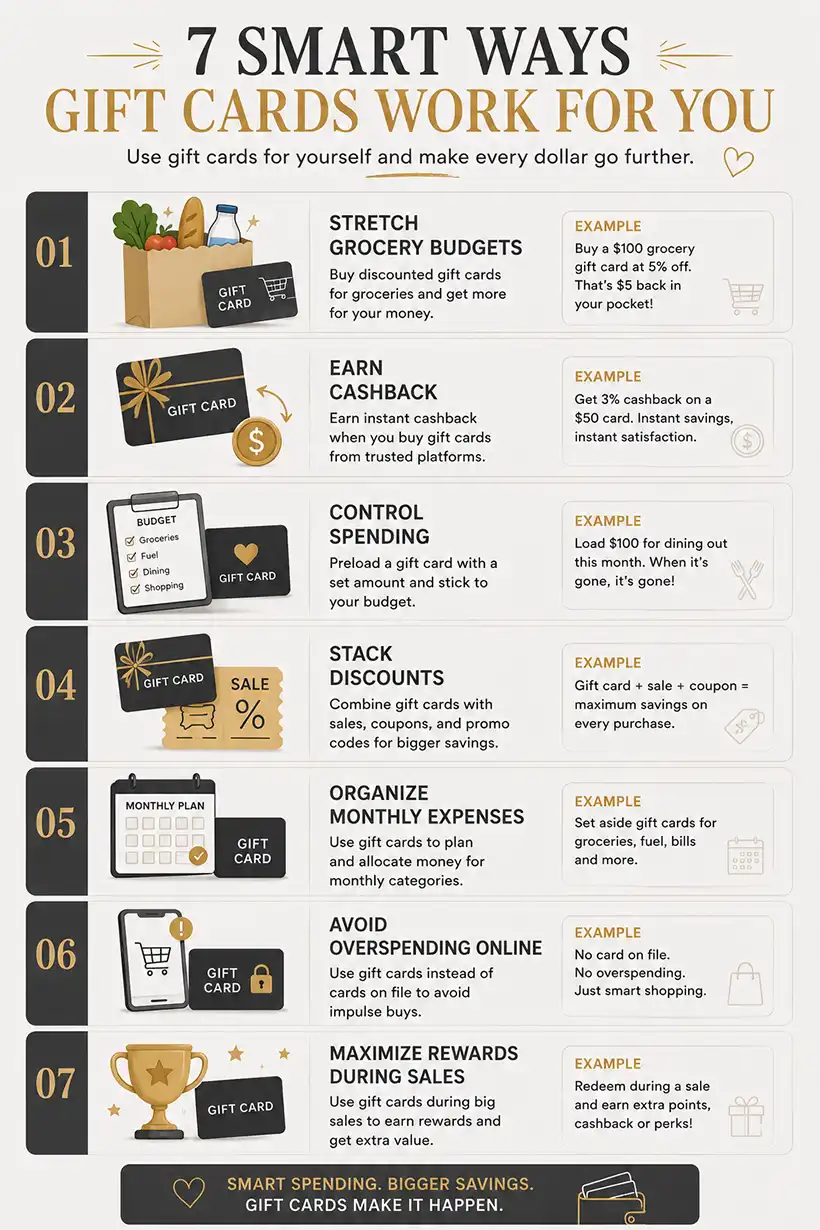
Basically, gift cards stopped being “gifts” and started acting more like flexible spending tools.
And once you notice it, you realize people are doing this everywhere.
At Target, Starbucks, gas stations. Or, for streaming subscriptions, fashion hauls, and everyday groceries.
Even my husband Rick — who once claimed gift cards were “financially pointless” — now buys digital restaurant gift cards before date nights because “the cashback basically pays for dessert.”
Character development.
‘Budgeting Trick’ That Weirdly Works
One of the smartest things about using gift cards for yourself is how naturally they create spending boundaries.
Instead of swiping your debit card endlessly and hoping for the best, you pre-load a spending amount intentionally.
That changes behavior fast.
A $100 grocery gift card becomes:
- “This is my grocery budget this week.”
- “Or my coffee savings this month.”
- And sometimes, “This is my shopping allowance until payday.”
And psychologically? It works better than people expect.
I started doing this accidentally during holiday sales.
I bought a discounted department store gift card because it came with cashback. Then I stacked it with coupons. Then I realized I’d basically reduced my shopping bill before checkout even happened.
That’s when the math starts feeling suspiciously satisfying.
Open Secret: Discounts Before You Even Shop
Here’s where self-use gift cards get interesting.
A lot of consumers deliberately buy discounted gift cards for places they already spend money at regularly.
Groceries | Gas | Coffee | Retail stores | Food delivery apps
So instead of spending $100 directly…
you might buy a $100 gift card for $95 equivalent value through cashback or rewards.
That’s essentially free savings for purchases you were already going to make anyway.
Claire explained it best:
“I stopped thinking of gift cards as presents and started treating them like pre-discounted money.”
Honestly? Hard to argue with that logic.
Cashback Culture Is Changing Everything
Part of why this trend exploded is because people now expect rewards from literally everything.
Credit cards | Shopping apps | Airline miles | Cashback extensions | Reward points | Digital wallets.
Gift cards slipped right into that ecosystem.
Platforms now offer:
- Instant cashback
- Promotional bonus credits
- Loyalty rewards
- Flexible digital wallets
- Multi-brand access
- Spend tracking
Which means people aren’t just buying gift cards anymore.
They’re optimizing them.
And yes, there’s absolutely a certain thrill in watching cashback hit instantly after buying something you were already planning to purchase.
Tiny serotonin boost. Financially responsible edition.
“But Isn’t It Easier to Just Use a Debit Card?”
Technically? Sure.
But gift cards create intentional spending in a way normal cards often don’t.
That’s why so many people use them for: Monthly budgeting, holiday shopping, dining limits, teen spending, travel funds or personal shopping allowances.
My college friend Anne uses coffee shop gift cards specifically because she was accidentally spending ridiculous amounts through delivery apps.
Now she buys one digital coffee card every month and refuses to reload it until the next month.
“It’s basically emotional damage prevention,” she told me dramatically.
She’s not entirely wrong.
The Rise of Fully Digital Gift Cards
The old version of gift cards had problems.
Plastic cards got lost. Balances disappeared. Nobody remembered how much was left. Half-used cards lived permanently in kitchen drawers.
Digital gift cards changed that.
Now people store everything in one place. Think of it as – real-time balances, instant access, mobile wallet integration, flexible redemption, partial spending and easy tracking.
That convenience matters more than people realize. Especially because modern shopping behavior is messy.
We shop online. In-store. At midnight. During sales. While doomscrolling TikTok.
Having a flexible digital balance actually fits how people spend now.
The Internet Discovered ‘Gift Card Stacking’
If you’ve spent enough time around deal forums or shopping TikTok, you’ve probably seen people talk about stacking strategies.
This is where people combine: Store coupons, Cashback offers, Sale pricing, Loyalty rewards and Gift cards.
All in one purchase.
And weirdly?
This works really well.
A lot of shoppers now deliberately buy gift cards before major sales because it creates an additional savings layer.
Rick calls this:
“Weaponized budgeting.”
I do admit, that feels accurate.
What Happens If You Don’t Want the Gift Card Anymore?
This is another reason self-use gift cards became more practical.
Because with platforms like PlusGiftCard, people can now, trade balances, sell unwanted cards, swap retailers, regift unused value and even exchange digital credits.
Which removes one of the biggest historical problems:
being stuck with a retailer you don’t actually use.
Modern digital gift card platforms are making gift cards feel less rigid and far more flexible than they used to be.
And that flexibility is exactly why people are starting to treat them like usable digital spending tools instead of occasional gifts.
So… Are People Actually Saving Money?
In many cases, yes.
Especially when they:
- Buy strategically
- Use cashback platforms
- Stack rewards
- Combine with store promotions
- Use cards intentionally for budgeting
Even small percentages add up surprisingly fast over time.
A few dollars saved on groceries, a little cashback on fashion purchases, discounted dining credits or bonus rewards during sales.
Individually they feel minor.
Collectively?
That’s often where smarter spending habits begin.
Platforms Like PlusGiftCard Fit Into This Shift
This is also why newer platforms like PlusGiftCard are starting to feel less like traditional gift card websites and more like smart digital spending platforms.
Because the modern shopper doesn’t just want “a card.”
They want digital flexibility.
With platforms like PlusGiftCard, people are using gift cards for themselves in ways that go far beyond basic gifting.
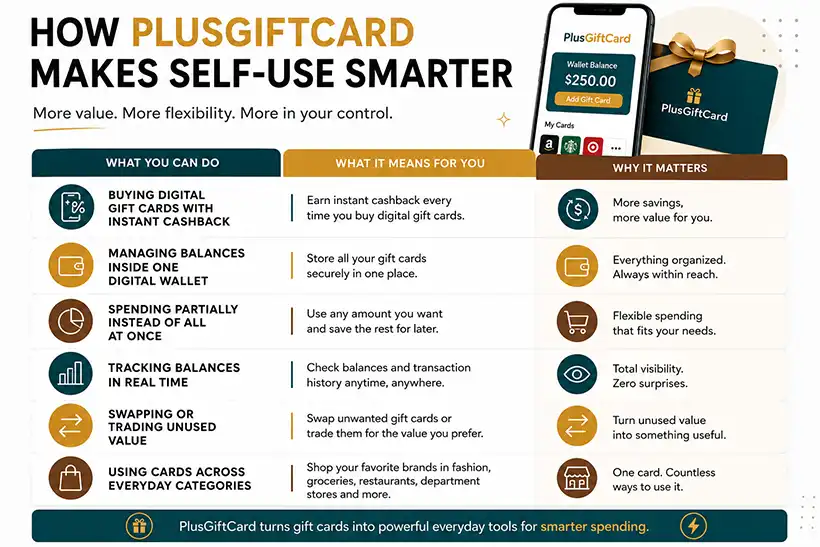
Which honestly makes sense for how people shop now.
Nobody wants unused balances trapped on forgotten plastic anymore.
The appeal of PlusGiftCard is that it turns gift cards into something more fluid:
part budgeting tool, part rewards strategy, part flexible spending wallet.
Rick recently described it as:
“Basically, cashback culture meeting adult financial organization.”
Shockingly accurate.
And because everything stays digital, it also removes the annoying parts people used to hate about gift cards.
You no longer have to worry about losing physical cards, forgetting balances, forced one-time spending, and wasted leftover amounts.
Instead, the experience feels more aligned with modern shopping habits:
quick, trackable, flexible, and surprisingly useful for everyday self-spending.
Which is probably why so many people no longer see gift cards as just “something you give other people.”
They’re becoming something people intentionally use for themselves.
Takeaway – Gift Cards Aren’t Just ‘Gifts’ Anymore
That’s really the biggest shift.
Gift cards used to feel passive. Now they feel useful.
They’ve become part budgeting tool, part shopping strategy, part rewards system.
And honestly, once you start using them intentionally for yourself, it becomes very hard to go back to spending the old way.
As Claire told me recently while proudly showing off her layered PlusGiftCard savings total:
“I’m not spending less. I’m just spending smarter.”
And, to me, that might be the most 2026 sentence ever.