Next Generation Gift Card
The global digital gift card market is experiencing explosive growth and is projected to exceed $1 trillion by 2030. Industry forecasts suggest the market could reach approximately $1.25 trillion by 2030, expanding at a remarkable compound annual growth rate (CAGR) of 16.6%. Digital gift cards already account for more than half of global gift card sales, while mobile wallet adoption, instant delivery technologies, AI-powered personalization, and enterprise reward programs continue to accelerate demand.
The transformation is significant. What was once a simple gifting option has evolved into a sophisticated digital asset capable of delivering personalized experiences, seamless payments, corporate rewards, and even AI-assisted purchasing journeys. As consumers increasingly prioritize convenience, flexibility, and personalization, the future of digital gift cards is becoming one of the most exciting developments in modern commerce.
At PlusGiftCard, we see this evolution every day. With access to more than 300 brands across categories including Apps & Games, Books & Toys, Department Stores, Restaurants, Electronics, Clothing, Shoes & Accessories, Food & Drinks, Auto & Gas, Gifts & Flowers, Grocery, Movies & Entertainment, Pets, Home & Furniture, Health & Wellness, Sports & Outdoor, Travel, Supermarkets, and Office Supplies, digital gifting is no longer limited to special occasions. It is becoming a smarter way to shop, reward, celebrate, and spend.
The question is no longer whether digital gift cards are the future. The question is how quickly that future is arriving.
Digital Gift Cards Are Becoming a Financial Planning Tool
One of the most overlooked developments in the future of digital gift cards is their growing role in personal budgeting and financial management. What began as a gifting solution is increasingly becoming a practical spending tool for consumers who want greater control over their everyday expenses.
Many shoppers now purchase digital gift cards for categories they regularly spend on, such as groceries, restaurants, entertainment, travel, fuel, and retail shopping. By allocating a specific amount to a gift card, consumers can better manage discretionary spending, reduce impulse purchases, and stay within monthly budgets. This trend is particularly appealing to younger, digitally savvy consumers who prefer structured spending methods without sacrificing convenience.
As digital payments continue to evolve, gift cards are expected to play a larger role in self-use purchasing habits. Rather than being reserved solely for birthdays and holidays, digital gift cards are becoming a smart way to plan purchases, maximize promotional opportunities, and create more intentional spending behaviors in an increasingly digital economy.
The Rise of Personalized Digital Gift Cards
One of the biggest digital gift card trends 2026 will continue to accelerate is personalization.
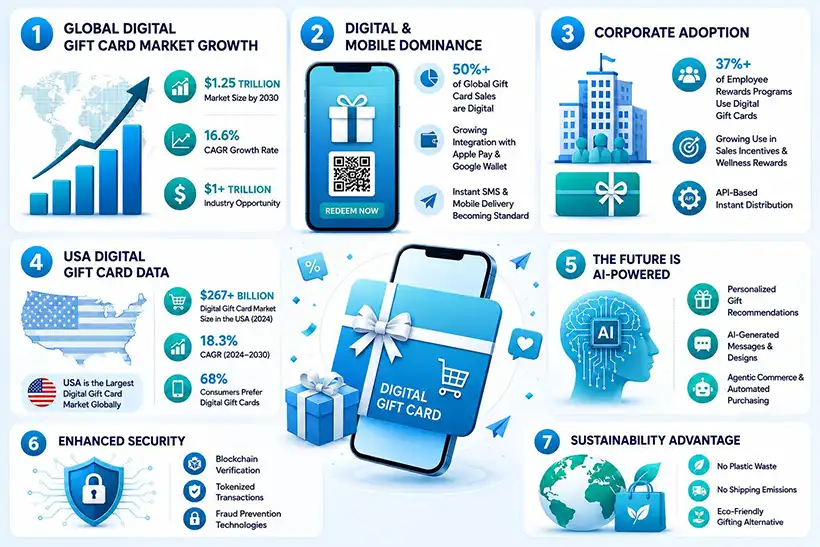
Illustration: The future of digital gift cards at a glance.
Traditional gift cards often carried a reputation for being convenient but impersonal. Modern technology is changing that perception entirely. Today’s consumers expect gifts that reflect their interests, preferences, and lifestyles. This demand is driving the rapid growth of personalized digital gift cards.
Instead of sending a generic card, users can now select designs based on occasions, add customized messages, schedule deliveries, and choose brands that align with the recipient’s interests. In the coming years, personalization will become even more advanced.
AI-powered systems will analyze gifting patterns and consumer preferences to recommend ideal brands and categories. A gaming enthusiast may receive recommendations for Apps & Games gift cards, while a travel lover may be matched with Travel & Rental experiences. Homeowners may appreciate Home & Furniture options, while wellness-focused consumers may prefer Health, Beauty & Wellness brands.
This shift transforms gifting from a simple transaction into a curated experience.
For consumers searching for digital gift cards for gifting, personalization helps create stronger emotional connections while maintaining the convenience that digital gifting is known for.
How AI Is Transforming Digital Gifting
Artificial intelligence is set to redefine the entire gifting ecosystem.
When discussing AI and digital gift cards, many people think only about product recommendations. In reality, AI’s role extends far beyond that.
The next generation of gifting platforms will use AI to simplify every stage of the gifting journey. Instead of spending time deciding what to buy, users will receive intelligent recommendations based on recipient behavior, shopping history, seasonal trends, and lifestyle preferences.
Future AI capabilities may include:
Personalized brand suggestions based on recipient interests, predictive gifting reminders for birthdays and anniversaries, AI-generated greeting messages, dynamic visual themes, and personalized digital unboxing experiences featuring videos, animations, and interactive content.
Perhaps the most exciting development is the emergence of agentic commerce. Payment providers are actively developing systems that allow AI agents to securely purchase and manage transactions on behalf of users. In practical terms, future consumers may simply instruct an AI assistant to select and send an appropriate gift card within a budget, and the transaction will be completed automatically.
As future trends in digital gifting continue to emerge, AI will make gifting smarter, faster, and more relevant than ever before.
Gift Cards Inside Mobile Wallets
The relationship between digital gift cards and mobile wallets is becoming increasingly important.
Consumers now expect every aspect of their financial lives to be available through smartphones. This expectation extends naturally to gifting.
Today, millions of users store payment methods inside mobile wallets such as Apple Pay and Google Wallet. The next stage of innovation involves deeper integration between gift cards and these digital ecosystems.
Future mobile wallet gift cards will be easier to store, manage, track, and redeem. Rather than searching through emails or messages for redemption codes, users will have all their gift cards organized in a single location.
This enhanced integration creates several advantages:
Faster redemption, improved visibility of balances, seamless in-store and online usage, enhanced security, and a frictionless customer experience.
For shoppers who regularly purchase electronics, fashion, food, entertainment, travel services, or grocery items, mobile wallet integration transforms digital gift cards into practical spending tools rather than occasional gifts.
As smartphone adoption continues to grow globally, mobile wallets will become one of the strongest drivers behind why digital gift cards are becoming more popular.
Corporate Gifting Goes Digital
Consumer gifting represents only part of the story.
The corporate sector is rapidly becoming one of the largest growth engines in the digital gift card industry. Current market data indicates that approximately 37% of employee-benefit and enterprise reward programs rely on API-driven digital gift card issuance.
Businesses increasingly use digital gift cards for employee rewards, customer incentives, sales contests, wellness initiatives, loyalty campaigns, and recognition programs.
The reasons are straightforward.
Digital gift cards offer immediate delivery, measurable results, broad recipient appeal, and reduced administrative complexity. Companies can reward employees instantly without managing physical inventory or dealing with shipping delays.
Automation is further accelerating adoption.
API-driven fulfillment systems allow businesses to issue gift cards in real time, track redemption activity, and generate detailed performance reports. This creates a scalable solution for organizations of all sizes.
As workplace culture continues emphasizing recognition and engagement, digital gift cards will remain a preferred reward mechanism across industries.
The Growth of Multi-Brand Gift Cards
Consumers increasingly value flexibility.
While single-brand gift cards remain popular, multi-brand gifting solutions are experiencing tremendous growth because they provide recipients with more freedom of choice.
The modern consumer shops across multiple categories and channels. A single person may purchase groceries online, stream entertainment services, buy electronics from major retailers, order restaurant meals through apps, and book travel digitally.
This shift has fueled demand for platforms that offer broad brand selection.
At PlusGiftCard, customers can access more than 300 brands across a wide range of categories. Whether someone is interested in gaming, fashion, restaurants, groceries, electronics, wellness products, pets, home improvement, or travel experiences, there is a relevant gifting option available.
This flexibility is becoming one of the most important benefits of digital gift cards in 2026.
Consumers no longer want limited choices. They want gifting solutions that align with diverse lifestyles and evolving purchasing habits.
Social Commerce and Instant Gift Delivery
Speed matters.
Modern consumers expect immediate results, and gifting is no exception.
The growth of social commerce is creating new opportunities for instant digital gifting. Social media platforms are increasingly influencing purchasing decisions, product discovery, and consumer engagement.
As these ecosystems evolve, digital gifting is becoming more integrated into social interactions.
Imagine discovering a product on social media and instantly sending a gift card to a friend without leaving the platform. This level of convenience is becoming increasingly achievable.
Combined with instant eGift card delivery, social commerce creates powerful opportunities for spontaneous gifting.
Forgot a birthday?
Need a last-minute thank-you gift?
Want to celebrate an achievement instantly?
Digital gift cards solve these challenges within seconds.
This convenience explains why how digital gift cards are changing the gifting industry is becoming such an important conversation among retailers, marketers, and consumers alike.
Sustainability and the Shift from Physical to Digital Gifts
Environmental awareness is reshaping consumer behavior across industries.
Gift cards are no exception.
Traditional physical gift cards require plastic production, packaging materials, transportation logistics, and retail distribution networks. Digital alternatives eliminate many of these environmental impacts.
As sustainability becomes a purchasing priority, consumers increasingly prefer digital options that reduce waste while maintaining convenience.
The transition from physical gifting to digital gifting supports broader environmental goals without sacrificing customer experience.
This trend is especially relevant for younger consumers who actively seek eco-conscious purchasing decisions.
By eliminating shipping requirements and reducing material consumption, digital gift cards align naturally with sustainability initiatives.
As a result, sustainability is emerging as one of the strongest long-term drivers behind digital gifting trends worldwide.
Enhanced Security and Emerging Trends in Gift Card Payments
As adoption increases, security becomes increasingly important.
Gift card providers are investing heavily in advanced protection technologies designed to combat fraud and improve transaction transparency.
One of the most discussed developments involves blockchain and tokenized digital assets.
These technologies can provide enhanced tracking, verification, and transaction security. While widespread implementation is still evolving, the potential benefits are substantial.
Future systems may offer:
Greater transaction transparency, improved fraud prevention, enhanced authentication, secure ownership verification, and stronger consumer confidence.
These innovations represent important emerging trends in gift card payments and will play a critical role in supporting future market expansion.
Consumers want convenience, but they also demand trust. Enhanced security ensures both objectives can be achieved simultaneously.
What the Future Holds for Digital Gift Cards
The future is not simply digital. It is intelligent, connected, personalized, and experience-driven.
Market growth, mobile wallet adoption, AI innovation, automation, and consumer demand are all converging to reshape the gifting landscape.
Digital gift cards are evolving beyond traditional gifting. They are becoming tools for shopping, employee engagement, customer loyalty, rewards programs, and everyday spending.
Asia-Pacific markets continue to lead adoption, supported by increasing smartphone penetration and digital payment ecosystems. Meanwhile, enterprises are embracing automated gifting solutions to improve efficiency and engagement.
Consumers benefit from greater personalization, faster delivery, broader brand selection, and seamless mobile experiences.
Businesses benefit from scalable reward systems, actionable insights, and stronger customer relationships.
The result is a rapidly expanding ecosystem that positions digital gift cards as a central component of modern commerce.
The Future Is Already Here — Experience It with PlusGiftCard
The future of gifting is no longer something to anticipate. It is already unfolding.
As the digital gift card market growth accelerates toward the trillion-dollar milestone, consumers are seeking platforms that provide flexibility, variety, convenience, and innovation in one place.
That is exactly what PlusGiftCard delivers.
With access to more than 300 brands across everyday essentials, entertainment, travel, fashion, dining, electronics, wellness, groceries, home improvement, and much more, PlusGiftCard offers far more than a traditional gifting experience. It provides a smarter way to celebrate, reward, shop, and connect.
Whether you’re looking to buy digital gift cards online, searching for the best digital gift card platform, exploring an extensive online gift card marketplace, or simply wanting reliable instant eGift card delivery, PlusGiftCard makes digital gifting effortless.
The future of digital gift cards is personalized. It is mobile. It is AI-powered. It is sustainable. Most importantly, it is designed around the way people live, shop, and connect today.
And that future starts with PlusGiftCard.